


Most pond owners pick a fountain pond pump based on price or whatever the store clerk recommends. That is the first mistake. A pump that is too small struggles to push water. A pump that is too big wastes energy and stirs up sediment you did not even know was there. Either way, you end up spending more money fixing a problem that should not exist.
Choosing the right fountain pond pump starts with understanding your pond. Not the one in the catalog photo. Yours. The one with the weird shape, the tree that drops leaves every fall, and the depth that nobody measured before filling it. Every pond has quirks, and those quirks decide what pump you actually need.
An incorrectly sized fountain pond pump does not just perform poorly. It shortens the motor’s life, messes with your pond’s ecosystem, and raises your electricity bill. The good news is that fixing the problem is not complicated once you know what to look for. Let’s break it down.
The Sizing Mistake That Kills Pumps Early
- Overworked and Underpowered: A pump that is too small for your pond runs constantly at full capacity. It never gets a break. That constant strain burns out the motor faster than you would expect. You might save $40 up front on a smaller unit, but you will spend twice that on a replacement within a year. Also, a small pump will not aerate your pond enough. The math does not work in your favor.
- Too Much Power, Too Many Problems: An oversized pump creates excessive water movement, disturbing the pond floor. Sediment kicks up, the water turns murky, and your fish start acting stressed. It also draws more electricity than needed, which adds up on your power bill month after month. Bigger is not always the answer, even when it feels like the safer choice.
GPH and Head Height: Two Numbers You Cannot Ignore
GPH stands for gallons per hour. It tells you how much water the pump moves in sixty minutes. A general rule is that you want a pump that can circulate the total volume of your small pond at least once every one to two hours. So a 500-gallon pond needs a pump rated at 250 to 500 GPH. Pretty straightforward once you know your pond’s volume.
But this is not the case for large ponds. You cannot be expected to circulate the water of a large pond every hour or even every day. As a general rule, a ¼ acre pond needs about a half-horsepower pump to circulate the water sufficiently. Really, though, it depends on total circulation, not horsepower. How many gallons per hour does your pump circulate? If your fountain uses a nozzle, as decorative fountains do, what is the net flow of water coming from the fountain? That is, the nozzle holes will restrict flow. Keep this in mind.
Head height is the vertical distance between the pump and the highest point the water needs to reach. This is where many people get tripped up. A pump rated at 500 GPH at zero feet of head height might only push 200 GPH at five feet. That spray pattern you imagined? It shrinks fast when you do not account for head height loss.
Matching the Pump to Your Pond, Not Your Neighbor’s
- Measure Before You Buy: Grab a tape measure. You need the length, width, and average depth of your pond. Multiply those together, then multiply by 7.5 to convert cubic feet to gallons. Write that number down. It is the starting point for every pump decision you make. Skip this step, and you are just guessing. Guessing with pumps rarely ends well. Or you can use our pond gallons calculator by clicking on the link.
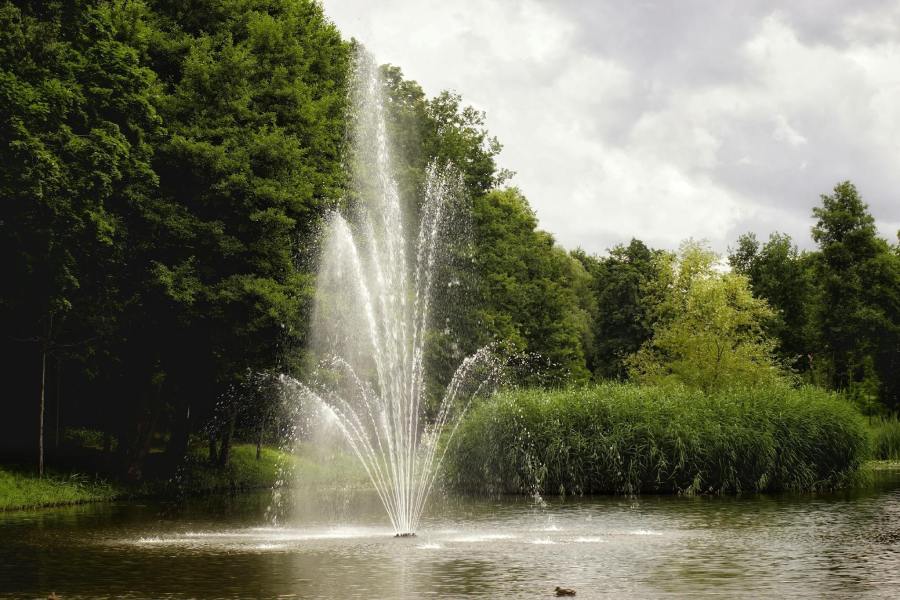
- Factor In Your Spray Pattern: Different spray patterns require different flow rates. A tall, narrow geyser needs higher pressure and more GPH than a low, wide mushroom pattern. If you want a spray that reaches three feet or more, you need a pump with enough power to maintain that height after accounting for head height loss. Check the manufacturer’s specs before you commit.
When Bigger Is Not Better

There is a temptation to just buy the most powerful pump you can afford. Feels like insurance, right? But an overpowered pump in a small pond creates a current that keeps fish from resting. It also agitates the bottom, pulling up organic debris that feeds algae blooms. You end up with green water and tired fish. Not exactly the peaceful backyard scene you were going for.
Energy costs matter too. A pump runs continuously in most setups. A submersible pump drawing 200 watts instead of 100 watts costs you roughly double in electricity over a season. That extra power goes to waste if your pond does not need it. Match the pump to the pond, not to some idea of what might be enough.
Signs Your Current Pump Is Fighting for Its Life

- Weak Spray and Strange Noises: If your fountain spray has lost height or looks uneven, the pump is telling you something. Either it is clogged, wearing out, or it was never the right size to begin with. Strange humming or grinding noises are another red flag. A healthy pump runs quietly. When it starts making noise, the motor is under strain and probably not far from failing. The most likely culprit is a clogged intake. Second most likely is clogged up nozzle holes.
- Rising Energy Bills With No Explanation: Your pump runs all day, every day. If your electric bill creeps up and nothing else in the house has changed, the pump might be drawing more power than it should. An undersized pump works harder to move the same volume of water. That extra effort shows up on your bill before it shows up as a dead pump sitting at the bottom of your pond.
The Bottom Line
Getting the right pump size is not about buying the most expensive option. It is about knowing your pond’s volume, understanding GPH ratings at different head heights, and picking a unit that fits your specific setup. Take the time to measure, check the specs, and think about what your pond actually needs. Your fish, your water, and your wallet will thank you.
Ready to restore your pond’s health? Explore high-quality pond systems and get expert guidance to ensure clean, oxygen-rich water year-round.
Frequently Asked Questions
I calculate the right GPH for my pond?
Measure your pond’s total volume in gallons, then choose a pump that circulates that volume once every 1 to 2 hours for small ponds. For larger ponds, use our pond size calculator. You do not need to circulate the water in large ponds nearly as often.
Does head height really affect pump performance that much?
Yes. Every foot of head height reduces GPH output. Always check the manufacturer’s performance chart at your specific head height before buying.
Can I use a fountain pond pump for aeration, too?
A fountain pump moves surface water, which adds some dissolved oxygen. For deeper ponds, a dedicated aeration system works better because it reaches the bottom where oxygen levels drop the most.
How often should I replace my fountain pond pump?
Most quality pumps last two to five years with proper maintenance. If you notice weak flow, uneven spray, or increased noise, it is probably time to start shopping.
Is a submersible pump better than an external one?
For most backyard ponds, a submersible fountain pump is easier to install and runs quieter. External pumps tend to suit larger commercial setups where access and maintenance are easier to manage.
Feature Image Source: https://images.pexels.com/photos/3822110/pexels-photo-3822110.jpeg